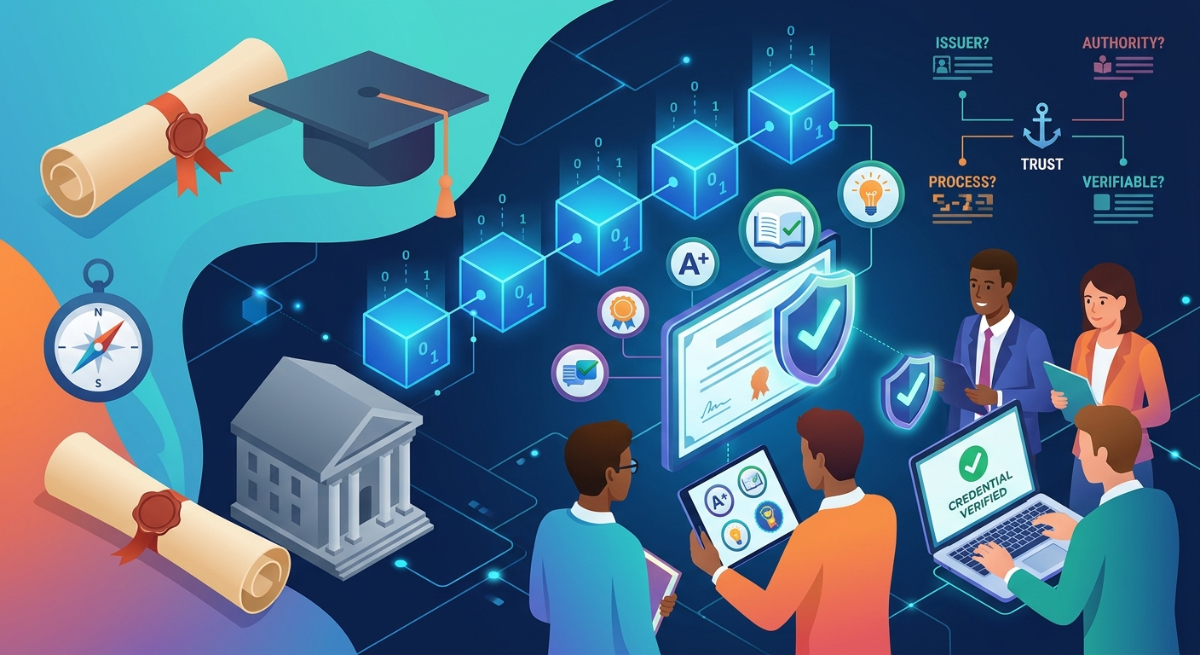
Verifiable digital credentials promise tamper-evident proof — and faster exposure of fakes. The technology changes the speed of checking, not the meaning of the achievement.
For readers evaluating any credential — their own or someone else’s — history offers a reliable compass. Ask who issued it, under what authority, after what process, and whether the claim can be verified independently. These four questions have separated genuine academic recognition from imitation since the first medieval licence to teach, and they will continue to do so however credentials are displayed.
Technology is reshaping the edges of this world rather than its foundations. Digital badges, verifiable credentials and blockchain-anchored diplomas promise tamper-evident proof of achievement, and several universities already issue them. The innovation does not change what a degree means; it changes how quickly a claim can be checked — and, by the same token, how quickly a fake can be exposed.
The question of what makes a degree real has a surprisingly practical answer: recognisable governance. Real degrees come from institutions that answer to a recognised authority, publish their standards, employ qualified faculty, and allow their qualifications to be independently verified. National arrangements differ, but the architecture of accountability is the constant.
A degree is, at its core, a claim of authority: an institution certifies that a person has met a defined standard. The philosophy behind the document is therefore a philosophy of trust. Society accepts the paper because it accepts the process behind it — admission, instruction, assessment and governance. Remove any of those and the paper remains, but the claim becomes empty.
Trust is the invisible infrastructure of academia. Every generation rebuilds it through honest assessment, accountable institutions and readers who ask where the paper came from.
Comments 0
No comments yet. Be the first one!
Leave a Comment